The introduction of ads to conversational AI will forever change the way we shop, says beefound.agency founder and AI Search specialist, Tom Harrison. The question now is, as consumers, can and should we trust them?
ChatGPT ads have landed in the UK, and it’s not getting enough attention. Although already old news to advertisers and the most ‘AI-pilled’ tech nerds, few habitual users are aware of the tidal wave change rolling towards them. And, if the reception of social media advertising is anything to go by, it’s going to be polarising.
What’s Up With ChatGPT Ads?
As of February 2026, OpenAI, the company behind ChatGPT, began testing in-platform advertising for a select few users in the US. In just a few months, the pilot expanded across borders – into Australia, Canada, Japan, New Zealand, South Korea, and, as of early June, the UK – evolving from straight eCommerce campaigns to include services ads, as more sophisticated features were gradually rolled out.
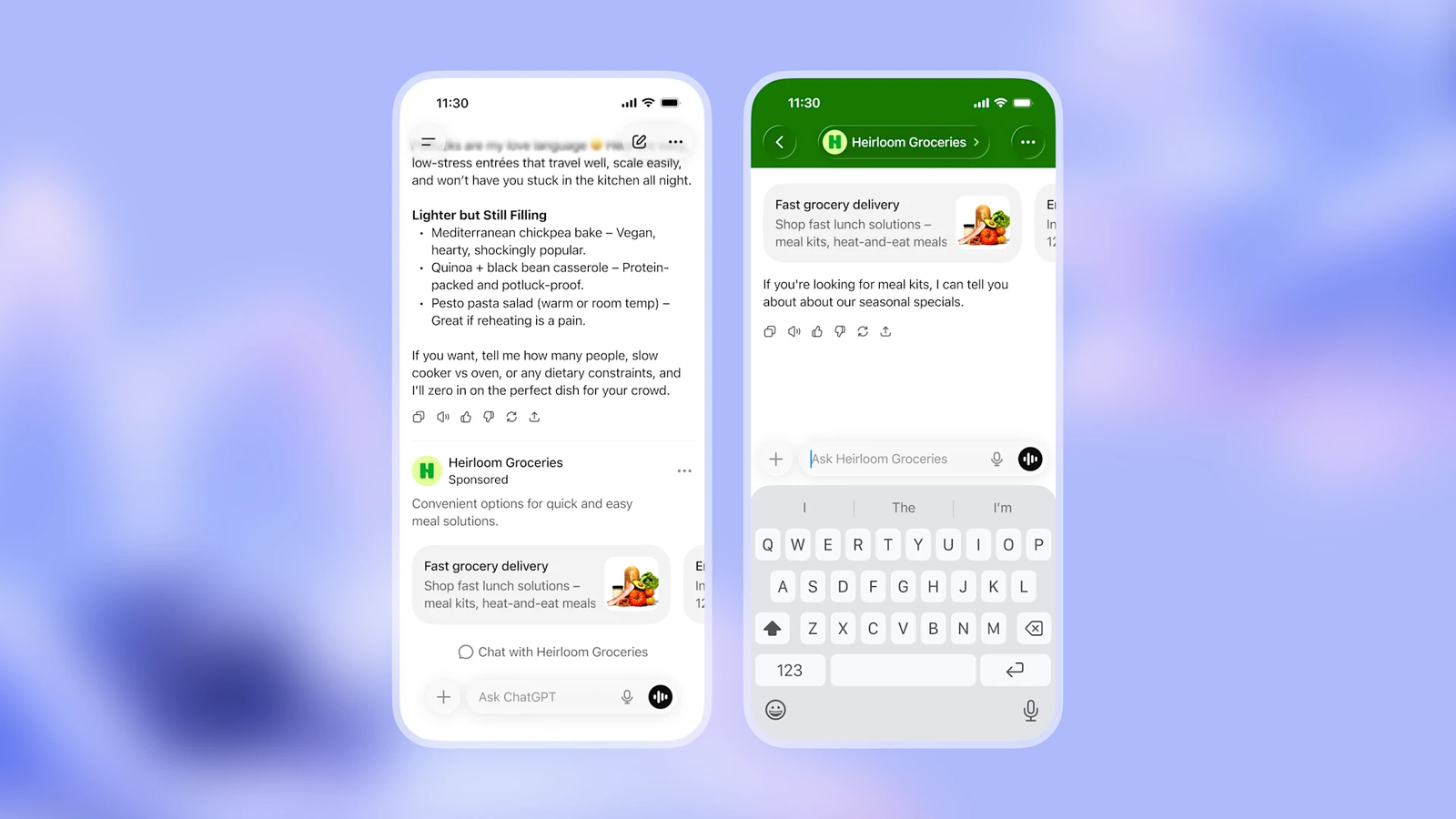
Currently, ChatGPT’s ads offering is still being trialled. The ads themselves look pretty rudimentary (small display-style ads with a snippet of text below your conversations), but the user interface is sharp and clean enough to be non-intrusive, which raises plenty of questions for the user experience. Namely, will this be OpenAI Ads’ final form? Will people readily be able to distinguish sponsored content from ChatGPT’s regular output?
Alongside this early-days testing, marketers have pointed towards OpenAI’s shiny new Ads Manager Beta as a telltale sign that the AI goliath is working towards its own ads ecosystem, ready to rival the likes of Google and Meta Ads.
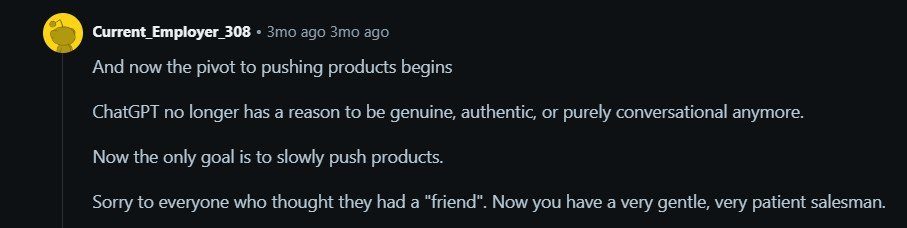
As users, we’re all about to become the product. Now many are worrying whether their digital advisor will turn into a sneaky salesman, and if you ask me, justifiably so.
A Whole New Can of Worms
Generative AI is an ethical minefield, fiercely debated by academics and artists. There’s a new controversy every week it seems, dogpiles that muddy an already complicated conversation and take the attention away from very real concerns. Enter this latest saga, and I expect the discourse to heat up.
OpenAI is on a mission to raise trillions of dollars over the next few years to support its infrastructure. With advertisers’ interests sprinkled into the equation, how can the average user trust what ChatGPT has to say?
Even if OpenAI asserts that ads don’t influence the chatbot’s responses and are kept visually separate from your conversations, they still have a passive influence. As with any ad type, there’s a sense of intrusion, however subtle, paired with a pressure to overconsume. And who’s to say this won’t change (read accelerate) in the future?
Personally, I’m in two minds about ads in conversational AI. With my beefound.agency hat on, I can see deep potential for my clients who are struggling for real estate in search engines and attention on social media.
As an individual, I worry about how quickly the technology is outpacing the oversight. Even from within the industry, it’s impossible to predict the future. The only thing we can be certain of is that governments are always going to be playing catch up with these ever-evolving and accelerating borderless technologies. We’ve long known social media is bad for kids, but it’s only very recently that administrations around the world have begun to do anything about it.
Valid Critiques
There are many reasons to be sceptical about large language models (LLMs): people are becoming increasingly reliant on them, which threatens diversity of opinion, and more chillingly, critical thinking and memory as an increasing number of mental tasks are ‘cognitively offloaded’ to GenAI.
This specific cocktail has AI ethicists particularly wary, not least because ChatGPT regulars are more trusting of the chatbot, and thereby, more susceptible to advertising on the platform. And that’s just the tip of a very overlooked iceberg.
Why Chatbots Up the Ante: The ELIZA Effect
Consider the intimate ways people use LLMs. Swathes of users are already going to ‘Chat’ for advice, reassurance, decision-making and support. You may have even heard of some of the most extreme cases, usually headlines along the lines of “I fell in love with ChatGPT”, or “My chatbot fed into my delusions”.
This reflects the model’s bias-reinforcing, ‘yes man’ leanings as well as the deeply human tendency to project human characteristics onto artificial intelligence (also known as the ELIZA effect). Many chatbots have been trained to respond sycophantically to encourage repeated use, which appears to be wildly effective.
A longitudinal study from Marc Zao-Sanders and Sara Biuk shows that in 2026 many of the top use cases of GenAI are emotional:
No. 1: therapy/companionship · No. 7: relationship advice · No. 10: general advice.
With 10% of Brits using GenAI daily, and one in four weekly, that’s a lot of users bypassing traditional methods of discovery like Google Search or social media. Here, there are few guardrails to speak of, not to mention the lack of informed human opinions that you might receive from a doctor, therapist, solicitor, or simply a close friend. Ostensibly, this opens the door to emotional manipulation. The fine line between tool and confidant, adviser and advertiser is being eroded continually.
Data & Profiling
Intimate conversations = intimate data. In the case of ChatGPT, the well is almost bottomless, unlike any other platform we’ve seen throughout history. People share personal details of their relationships, finances, health struggles or just their inner thoughts. Instantly, that raises trust questions.
The reason being that once a product clinches a wealth of emotional data, the doors open to emotionally tailored ads that target users when they’re most vulnerable – even if OpenAI says it won’t share user data directly with advertisers. Here, we wade into a grey area.
We can probably all agree that ChatGPT advising on medical surgery is a bad thing. But a cosmetic clinic advertising treatments that are completely legal and widely available to a body-conscious user? What about a recently divorced parent letting off steam about their money troubles? Should they see ads for loan companies or credit cards? The difficulty, without specific regulation, is knowing where OpenAI will draw the line.
These sorts of ethical implications are exactly why legislation exists: to hold advertisers and platforms accountable for potential harms they might cause. And while the same privacy and autonomy issues exist on platforms like Instagram and Google, the level of awareness is incomparable. People are much more savvy about digital advertising than they have ever been (case in point: ad blockers and ‘ad blindness’); but no one is ready for LLM ads.
Platform Bias
Among the broader platform-level critiques being levelled at OpenAI, response bias is one of the most contentious. The platform isn’t neutral. Trained on a biased dataset, we can expect certain topics or themes to crop up more than others. This might influence user behaviour, which then – although indirectly – skews the separate systems on which the ads run.
Incentive Risk
Let us not forget the impact of advertising incentives, either. As OpenAI strives to keep its stakeholders happy, we can’t expect the platform’s priorities to stay fixed forever. History teaches us that the self-regulation of digital platforms only goes so far, given its tendency to weaken users’ welfare under commercial pressures.
As the early days of social media have shown, it often takes a tragic event or an explosive controversy for regulators to step in. Likewise, when the internet became widely available parents were afraid and kids could look up literally anything, so the ISPs had to jump in with parental controls. It’s similar here.
A Canary in the AI Coalmine or Overblown Concern?
OpenAI’s critics, Anthropic included, suggest that the inclusion of conversational AI ads undermines the efficacy of AI assistants whilst compromising the well-being of the most vulnerable users. Some AI ethicists like Catharina Doria even predict they will contribute to platform decay creep, the models inevitably becoming optimised for longer conversations, higher engagement and more opportunities to sell. Others argue that the risk will be reined in by responsibility, as big corporations may pull out in the event of anything that may harm their brand reputation.
For me, I believe we have a collective responsibility to educate ourselves on AI. It’s up to us to inform users and help consumers understand when they’re being advertised to and how to protect themselves, especially in the beginning.
Spotting an Ad in ChatGPT
Fortunately, advertisements in ChatGPT are designed to be visually distinct from its AI-generated responses. Users can identify ads through these simple characteristics:
- Ads are clearly marked with a “Sponsored” label.
- They appear in a dedicated section of the interface, separate from the conversation itself.
- You’ll find them beneath the assistant’s response.
- They are never integrated directly into ChatGPT’s generated text as part of the answer.
So, What Next?
A year is a long time in the AI bubble, but right now, all the signs are pointing towards global rollout and the formalisation of a fully fleshed-out ChatGPT ad platform, poised to disrupt performance marketing as we know it. While Anthropic and Gemini are reluctant to follow suit, both are burning through billions of dollars on AI infrastructure, in the midst of a global energy crisis, I might add. Integrating ads into the user experience might be the only sustainable long-term solution.
Echoing Google’s trajectory from link directory to AI-powered research partner, as AI assistants more closely resemble ad platforms, users will need to acquire a new ‘AI literacy’. Regulators, at the same time, should push for greater transparency, the auditability of algorithms and tighter restrictions on certain use cases.
Just as spotting fake news or hidden influencer marketing has been normalised in the public consciousness, we’ll all need to hone our digital skills to recognise when our AI advisor has become an advertiser.
To stay on top of what’s happening, you can find updates from official sources over at OpenAI.

Koupe Media
Koupe Media
Practical digital marketing insight from Koupe Media, focused on useful strategy for UK SMBs and startups.