Target
Commercial intent
We focus on keywords and pages that bring in qualified enquiries, not just traffic.
Koupe Media helps UK SMBs grow through SEO services with clear strategy, honest reporting and work designed to compound over time — not quick wins that disappear after the next update.
Website Health Check = broader digital review. SEO Audit = focused SEO assessment. Prefer a wider view? Start with the free Website Health Check.
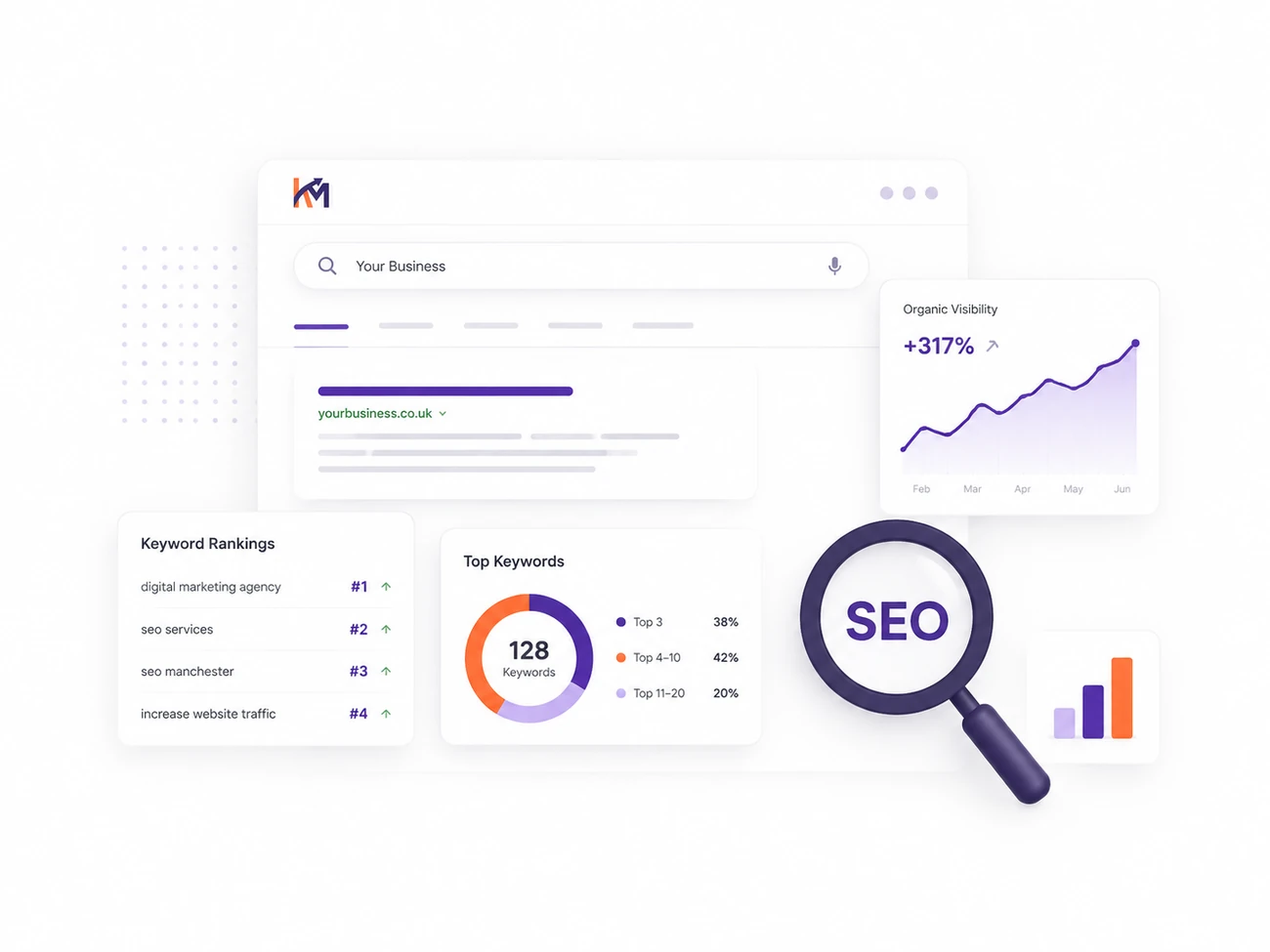
Broad SEO overview first, then the right route for your business:
Local SEOeCommerce SEOSEO AuditSEO growth guideThis page is our broad commercial SEO overview. It’s designed to help you understand where SEO fits, which type of strategy suits your business, and what the best next step looks like. Whether you run a lead generation website, a local business, an online store, or a growing SMB with multiple service lines, the goal is the same: improve visibility for the searches that drive revenue.
SEO compounds over time — and many SMBs combine it with Paid Social or PPC while organic visibility grows. For broader support beyond SEO, explore our digital marketing services.
Start with the section that fits your business — or use an SEO Audit if you want clarity first.
Commercial service pages, qualified enquiries and conversion-aware SEO.
Explore this route → 02Local businessesMap visibility, location intent and stronger local search presence.
Explore this route → 03eCommerceCategory, product and revenue-intent visibility for online stores.
Explore this route → 04Growing SMBsPractical priorities and sustainable progress without enterprise complexity.
Explore this route →Start with a broader Website Health Check or a focused SEO Audit and we’ll recommend the clearest next step.
For lead generation websites, SEO is about more than rankings. The real goal is to turn search visibility into enquiries. That means targeting commercial intent, improving service pages, reducing friction, and making sure the site supports the conversion journey after the click.
We usually prioritise core service pages, internal linking, content that supports buying decisions, and technical fixes that improve crawlability and trust. For many SMBs, this is where the biggest commercial gains show up first.
If your business relies on enquiries rather than transactions, this is often the strongest SEO model to build around. For proof of how this can work, explore our case studies.
Explore SEO case studies →We focus on keywords and pages that bring in qualified enquiries, not just traffic.
Core service pages are usually where the best lead-generation gains are made first.
Better rankings matter more when the page is designed to turn interest into action.
Local SEO is usually the right route when your business depends on visibility in a defined area. That might mean ranking in the map pack, improving your Google Business Profile, strengthening location pages, or increasing visibility for “service + location” searches.
For trades, clinics, professional services and other local businesses, the aim is simple: show up when nearby customers are ready to enquire. Our Local SEO page goes deeper into maps, location pages, local relevance and ranking factors.
We also have dedicated SEO pages for Manchester, Newcastle and Chester.
eCommerce SEO has a different job to do. It needs to improve visibility for category pages, product pages, and high-intent search terms that drive revenue. Site structure, internal linking, crawl efficiency, product content, and commercial search intent all matter more.
For online stores, SEO is often a balance between technical structure and commercial page optimisation. If you’re selling products online, our eCommerce SEO page covers the details in more depth.
The priority is not just “more traffic” — it’s better visibility for the pages that lead to sales.
Explore eCommerce SEO →Category pages often carry the strongest commercial SEO opportunity in eCommerce.
Internal linking and crawl structure affect what search engines can find, prioritise and rank.
The goal is stronger visibility for pages that contribute directly to sales, not vanity traffic.

Most SMBs need practical SEO, not enterprise complexity. That usually means a clear plan, sensible priorities, and execution focused on the pages and issues most likely to drive results first. We don’t believe in bloated retainers or endless recommendation lists. We focus on what moves the needle.
For many SMBs, SEO works best when combined with realistic timelines, conversion-aware pages and consistent improvement cycles. It’s about building an acquisition channel that becomes stronger over time.
If you want a commercially grounded SEO partner rather than a generic agency process, that’s where we fit best. For a broader view of how we support founder-led brands, visit our digital marketing for SMBs page.
SEO should become a steady, compounding source of visibility and demand — not another channel that feels confusing or fragile. Download the SEO growth guide →
Use this page as the broad commercial overview, then choose the most relevant specialist service.
For service-based businesses that want more visibility in map results, local rankings and area-based searches.
Explore Local SEO → ECOMFor online stores that need better visibility for product and category pages that drive revenue.
Explore eCommerce SEO → CHECKFor businesses that want clear priorities, quick wins and an SEO-only starting point before committing to a wider plan.
Explore SEO Audits → AGENCYFor agencies that want dependable fulfilment without building the delivery function in-house.
Explore White Label SEO →We focus on visibility, traffic quality, enquiries and sales — prioritising quick wins where they exist while building long-term momentum.
We refined the SEO foundations, strengthened targeting, and focused on the pages most likely to generate commercial enquiries — creating a clearer route from search to conversion.
Results vary by business, market, starting point and investment. These figures relate to individual client outcomes rather than guaranteed results.
Selected client results are specific to the client, reporting period, starting position and measurement method. Past performance is not a guarantee of the same outcome for another business.
Practical SEO, sensible priorities and clear communication for growing businesses.
Better traffic beats more traffic. We align SEO to commercial intent so visitors are more likely to convert.
No endless recommendation list. We identify what matters most and work in the right order.
You’ll always know what we’ve done, why it matters and what’s next — in plain English.
Practical SEO that delivers outcomes without enterprise retainers or unnecessary complexity.
As your business changes, your SEO priorities change too. We adjust strategy based on performance and opportunity.
Structured execution, sensible priorities and reporting you can actually understand.
We review your site, technical health, visibility and commercial opportunities to find the real blockers and quickest wins.
We build a plan around the pages, fixes and opportunities most likely to move the needle first.
Improvements are implemented, tested and refined using real performance data.
Clear reporting and commercial priorities mean you always know what’s happening and why it matters.
Most businesses don’t start with a perfect plan — and that’s normal. We usually begin with a free Website Health Check, identify quick wins and priority gaps, then recommend the best next steps. For SEO-only clarity, start with a free SEO Audit.
Rather than anonymous testimonials, we use real client feedback and published campaign outcomes to show what our SEO work can look like in practice.
“Liam and his team at Koupe Media have played a pinnacle role in the growth of Neaco.
Neaco’s SEO programme focused on the foundations that affect how the right customers discover and use the website: technical SEO, keyword and search-intent research, on-page optimisation, content improvements, internal linking and stronger commercial page targeting.
The work was measured through real search and website-performance data rather than ranking movement in isolation. Published results include +212% organic sessions year on year, +300% qualified inbound leads, 80% growth in ranking keywords and 50+ position improvements across core terms.
Those figures are specific to Neaco’s starting point, market, implementation and reporting period, so they are not presented as a guarantee. They show why our SEO approach connects visibility with enquiries and commercial intent instead of treating keyword rankings as the end goal.
For a specialist B2B manufacturer, that meant understanding how architects, contractors, specifiers and buyers search at different stages of a project. Product and solution pages needed to answer commercially useful searches, while technical information and supporting content needed to help people research with confidence. The campaign therefore prioritised crawlability, indexability, metadata, headings, page copy, internal pathways and content opportunities together rather than treating them as unrelated tasks.
Performance was then reviewed across organic visibility, landing-page traffic and enquiry activity. That combination matters because a ranking only has value when it attracts a relevant visitor and helps them move towards the next commercial action. It is the same principle we use when prioritising SEO work for other SMBs: fix the foundations, align pages to real search intent, improve the user journey and measure whether visibility is contributing to meaningful business outcomes.
See the full SEO case study →Quick answers to the questions we hear most from business owners.
Ask Us a Question →It depends on your starting point and competition. Some technical and on-page changes can move within weeks, but meaningful growth usually builds over several months. The aim is momentum that compounds — not short-lived spikes.
Yes — when it’s focused on intent and conversions. SEO helps you appear when customers are actively searching for your services or products, which makes it one of the strongest long-term acquisition channels for many SMBs.
Local SEO focuses on visibility in a defined area, map pack rankings and location intent. Broader SEO usually targets national or wider commercial searches. If location visibility is the key opportunity, see Local SEO.
Yes. eCommerce SEO usually revolves around product and category visibility, site structure and revenue-intent pages. Lead generation SEO is usually more focused on service pages, enquiries and conversion journeys. Explore our eCommerce SEO page for the fuller breakdown.
We cover the fundamentals that drive sustainable growth: technical SEO, on-page optimisation, content priorities, internal linking and ongoing improvements based on performance data. For a focused starting point, begin with an SEO Audit.
Costs depend on competition, site complexity and how quickly you want to grow. We keep plans practical for SMBs and scale based on what’s commercially worthwhile. View typical investment ranges on our pricing page.
No — we work with businesses across the UK. We also have dedicated local pages for Manchester, Newcastle and Chester.
Start with a free Website Health Check. We’ll review your site, highlight quick wins, identify priority gaps and explain the best next steps in plain English. For SEO-only clarity, use the free SEO Audit.
We’ll review your website, highlight quick wins and priority gaps, and recommend the best next steps in plain English. Need a wider digital review? The free Website Health Check covers SEO, PPC and Paid Social.
Share your current position, target markets and what you want organic search to achieve. We’ll come back with the clearest next step.
Prefer to start with a complimentary SEO Audit? View this option →